

 Home
Home

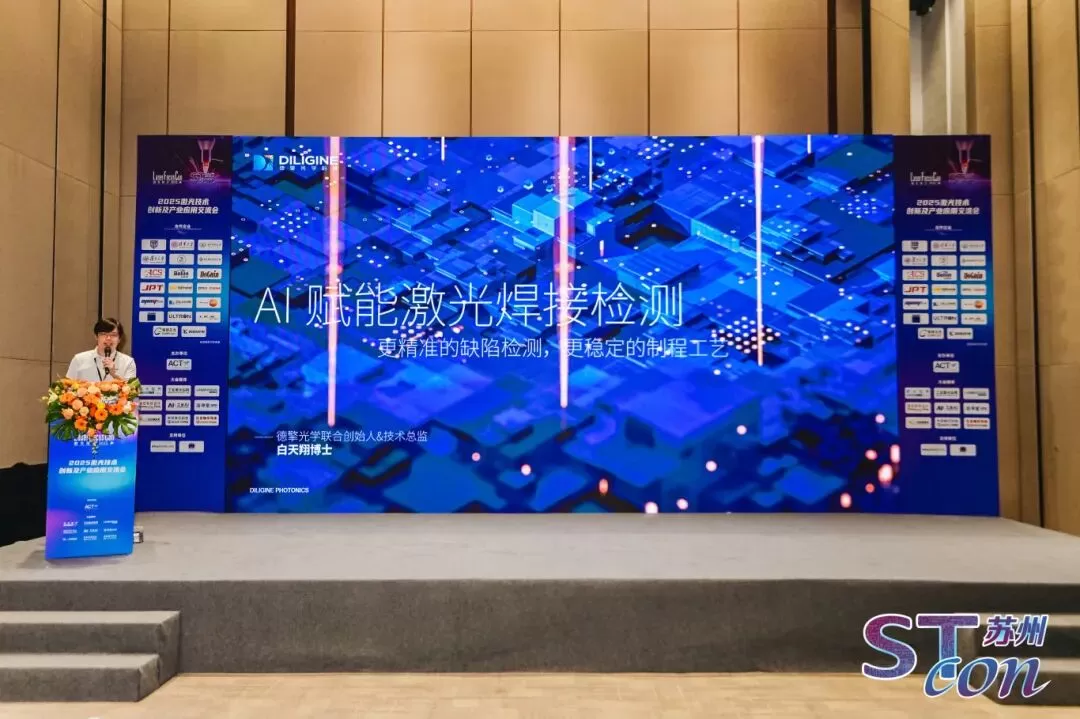
On May 21, 2025, the STcon Smart Technology and Applications Conference commenced in Suzhou. As a laser industry sub-forum, "LaserFocusCon Laser Gathering" brought together industry experts, scholars, and leading enterprise representatives from both China and abroad. Diligine Photonics was invited to participate in discussions on advanced laser technology and smart manufacturing.
At the conference, Dr. Bai Tianxiang, Co-founder and CTO of Diligine Photonics, delivered a keynote speech sharing advancements in laser welding defect detection for the AI era.
The full text of the speech is provided below. We welcome your exchange and discussion.
This content is simultaneously published in the May 2025 issue of "Laser World" magazine.
Laser welding, characterized by low heat input, high precision, and high speed, is a key process in precision manufacturing. Precisely because of its high-precision nature, even minor process anomalies can lead to quality defects.
In 2024, the Diligine Photonics R&D team released patented detection technology that deeply integrates AI with photoelectric inspection. Tested and validated on real production lines, it aims to break through traditional inspection bottlenecks, now enabling more efficient and accurate quality control.
01. Pain Points of Traditional Welding Inspection
Laser welding involves complex physical metallurgical processes, such as molten pool dynamics, heat accumulation, and grain growth, which easily lead to defects like pores, cracks, and warping deformation.
Since the laser welding process exhibits distinct multi-spectral radiation characteristics—the visible light band indicates the amount of metal vapor eruption and spatter degree, reflected laser light indicates the workpiece's laser absorption, and the near-infrared band reflects molten pool temperature fluctuations—the mainstream solution for online laser welding inspection is photoelectric detection. This involves real-time monitoring of the optical radiation generated during welding, converting it into electrical signals, then performing real-time analysis and anomaly identification on these signals to issue timely alerts, thereby assisting in process intervention and quality control to reduce defect rates.
Traditional photoelectric detection algorithms for welding processes typically compare the current welding signal with a baseline generated from normal signals, extract differences, and calculate signal features such as fluctuation limits, mean offsets, and variance. Defect detection is then based on whether these features exceed set threshold ranges.
In practical application, as the detection system's accuracy relies on feature selection and the threshold setting range for each feature, it constantly requires adding newly extracted features based on the signal characteristics of NG (defective) workpieces in laser processing inspection scenarios.
To ensure all NG workpieces are detected, the manually defined feature threshold ranges are relatively narrow. The advantage of this method is that it requires only a small amount of initial data to establish a baseline and set thresholds, facilitating rapid deployment. However, the disadvantage is also evident—detection accuracy and efficiency highly depend on manual experience. It cannot exhaustively traverse all possible combinations of feature threshold ranges like a computer can, leading to a certain proportion of OK workpieces being misjudged as NG (i.e., "over-rejection").
02. Diligine Photonics' Solution: Auto-Tuning + AI Fusion Detection
To overcome the instability caused by reliance on manual experience and effectively reduce the "over-rejection rate," the Diligine Photonics team further optimized the existing inspection process using AI technology, achieving AI-based automatic parameter adjustment.
By importing the same small number of OK and NG signal samples used for manual tuning, the AI auto-tuning uses data-driven algorithms to analyze the importance of each signal feature and its contribution to the judgment result. Combined with a pre-trained process library model, it derives the optimal combination of threshold ranges. This combination can minimize "over-rejection" while ensuring zero "missed defects."
Building upon the already minimized "over-rejection rate" achieved through auto-tuning, the Diligine Photonics R&D team adopted a deep learning-based AI detection model to further improve detection accuracy, achieving fusion detection that combines traditional and AI algorithms.
03. Employing Deep Learning to Further Reduce the "Over-Rejection Rate" by 50%
Although traditional detection algorithms using manually designed features can distinguish most OK and NG signals, they are ineffective for samples with very similar waveforms. Therefore, the Diligine Photonics R&D team employed an end-to-end model based on deep learning to further enhance detection accuracy.
Statistics from real production line data show that AI fusion detection effectively reduces "over-rejection" by 50%, significantly improving inspection precision on precision manufacturing lines, reducing workpiece waste, and enhancing production efficiency.
Step 1. Delving into Defect Data from Real Production Lines
Based on processing results collected online from real production lines using its self-developed Welding Defect Detection (WDD) system, the Diligine Photonics R&D team constructed a production line dataset with high coverage and high label quality. This dataset was used to train an intelligent inspection system "derived from and applied directly to the production line."
In practice, NG data samples are often difficult to obtain. Benefiting from years of in-depth research on laser welding mechanisms and failure mode analysis correlating production line NG signals, the Diligine Photonics team developed a data augmentation algorithm. By simulating defect signals, it requires a minimum of only 50 NG samples to generate over 50,000 simulated NG samples, solving the data imbalance problem for AI model training.
Step 2. Training the Machine Learning Model
Based on the above production line data and deep learning neural network design principles, the Diligine Photonics team built an AI model for welding defect detection. Its model framework is flexible and can be extended to include various algorithm structures such as Convolutional Neural Networks (CNN), Recurrent Neural Networks (RNN), Random Forest (RF), and Support Vector Machines (SVM).
Subsequently, the Diligine team used real production line NG data to fine-tune the model over multiple rounds, making the learned defect distribution align closely with the actual defect distribution under working conditions. This resulted in a fine-tuned sub-model. Repeating this step yielded multiple fine-tuned sub-models. An ensemble modeling approach was then used to integrate these multiple sub-models into a unified machine learning model. After multiple rounds of validation, this model demonstrated a stable ability to judge data conformity and can be directly deployed on production lines.
After training, the AI system selects the NG results from WDD online monitoring for intelligent re-judgment, updating the results to improve judgment accuracy. At this point, the AI model is successfully applied to defect detection in laser processing, outputting defect judgment results (OK/NG), defect types, and process improvement measures.
Step 3. Fusion of Traditional and AI Algorithms
By fusing existing multi-spectral optical detection algorithms with AI detection algorithms, Diligine Photonics achieved a reduction in the number of "over-rejections" under the condition of "zero missed defects," significantly saving substantial production costs.
For each workpiece, the traditional algorithm is first used for a preliminary judgment. If the traditional algorithm judges it as OK, no further judgment is made, and the traditional algorithm's result is used as the final result. If the traditional algorithm judges it as NG, it enters the AI inspection process for re-judgment, and the AI detection result is used as the final result.
The traditional algorithm has the advantage of rapid deployment, and its preliminary judgment results can effectively improve the efficiency of collecting training data for the AI detection model. As the AI detection model completes training, its precise discrimination capability can be utilized to further reduce the "over-rejection rate."
Beyond WDD+AI fusion detection, Diligine Photonics is also exploring AI-based multi-sensor detection technology. This involves feeding sensor data from pre-weld control, in-process monitoring, and post-weld measurement stages into an AI server to achieve automatic fault diagnosis through model training. Products like the Diligine Photonics Laser Focus Sensor (LFS), Laser Power Monitor (LPM), Welding Depth Measurement (WDM), and Optical Tomography Scanner (OTS) will all be empowered by AI fusion detection to provide customers with more efficient and accurate quality inspection data.
In the future, Diligine Photonics will collaborate with more customers on joint R&D to further enhance the performance of AI-based automatic fault diagnosis and achieve real-time closed-loop optimization of process parameters through digital twin technology. As this system rapidly penetrates fields like 3C electronics and power batteries, "Made in China with Intelligence" is establishing a new benchmark for quality inspection in the laser welding domain.